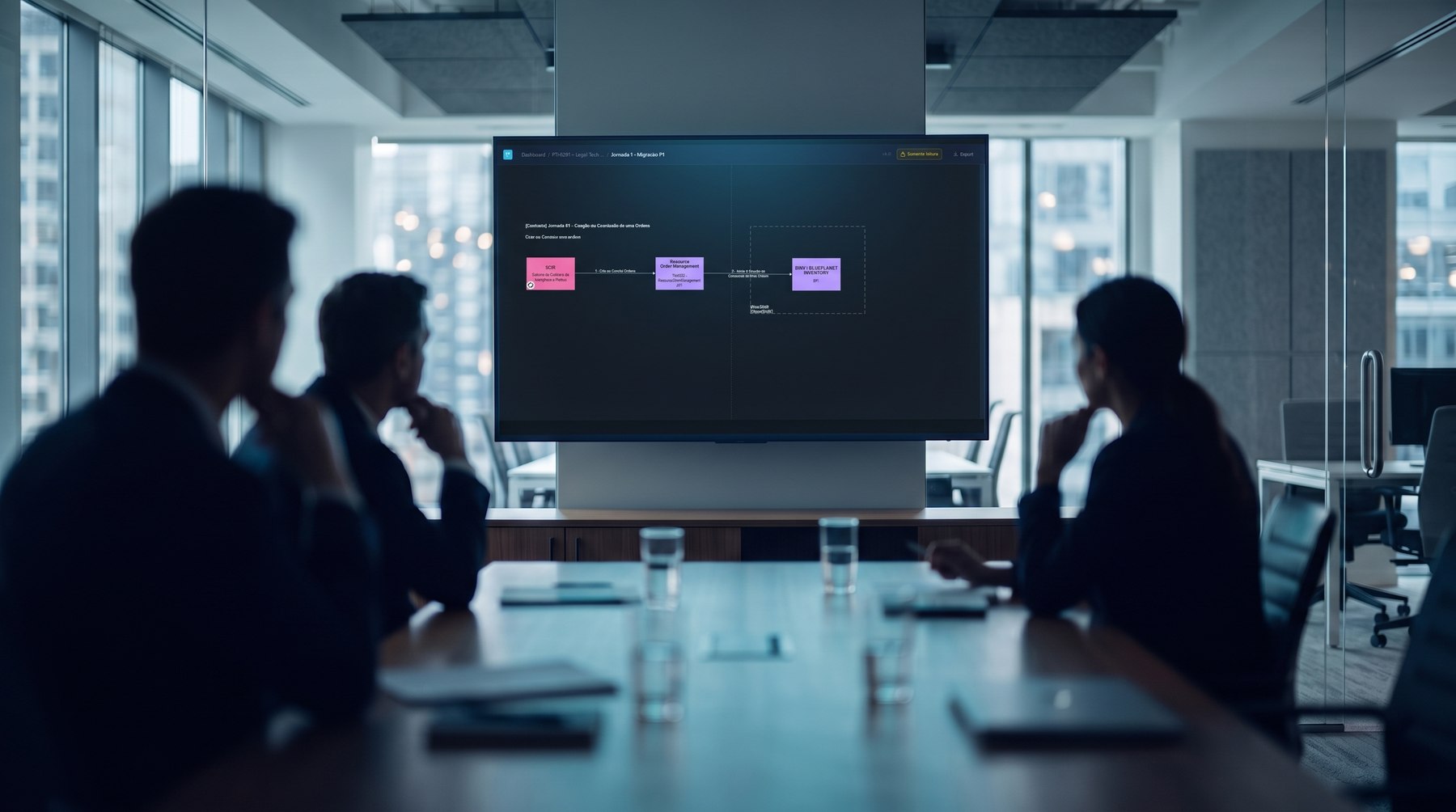
Everything your IT has, why it has it — and what to do next.
The platform that connects strategy, business capabilities, technical inventory, and governance — with native TOGAF methodology, C4 modeling, and artificial intelligence. Born in Brazil, built for the world.
Operational TOGAF, not a consulting slide
Templates for every phase, the Solution Document, and the Technical Architecture Document all live in the product's wiki — with versioning, publishing, and PDF export.
Management
Templates per phase
Every phase A–H has a ready-made wiki structure, with guided blocks instead of a blank page.
Solution Document and Technical Architecture Docs
One Solution Document per initiative, with child Technical Architecture Documents organized as a tree.
Versioning and PDF export
Revision history, controlled publishing, and PDF export at any time.
What's alreadyin production, today.
No one knows, with certainty, what exists in the IT estate
The picture of your applications lives in outdated spreadsheets, dead wikis, and the memory of a few key people. Simple questions go unanswered with any confidence: What's critical? What's obsolete? Who owns each system? What does this project impact?
The consequence is expensive: blind investment decisions, invisible security risks, slow audits, and dependence on a handful of heroes.
One single source of truth for the company's architecture
Every link is navigable and auditable: from the strategic objective down to the code repository of the artifact that supports it — and back.
Strategy
Towers, strategic objectives, and initiatives.
Business
Capability map across 4 levels (L0 to L3).
Applications
C4 inventory: application, provider, component, artifact.
Governance
Decisions (ADR), deviations, requirements, and releases.
Built-in methodology: TOGAF (phases A–H), C4 Model, ADRs, and traceability are part of the product, not a separate manual.
10 reports that answer before the question is asked
The data your inventory already collects — criticality, lifecycle, exposure, owners — becomes executive-level insight with one click, filterable by tower and segment.
Technology Radar
Lifecycle-stage maturity, Tech Radar style — market view, powered by your company's own data.
Technology Obsolescence
Real end-of-support dates (endoflife.date) cross-referenced with the artifacts that still depend on them.
Criticality × Business Impact
A matrix that plots how critical an application is against the size of the impact if it fails.
TIME Portfolio
Tolerate / Invest / Migrate / Eliminate classification — the same model used by market analysts.
Impact Analysis
Select a system or a tower and see the blast radius: affected domains, applications, and critical artifacts.
+ 5 more reports
Landscape by domain, security exposure, governance (ownership and offboarding), portfolio distribution, and obsolescence risk.
Everything your architecture team needs
From technical inventory to strategic governance, in one integrated platform.
C4 Technical Inventory
Register and browse Applications, Containers, Components, and Artifacts organized across the 4 levels of the C4 Model. With custom fields per entity.
Initiatives and Projects
Manage initiatives by project type (Business, Solution, Data), owners, budget, status, and links to strategic objectives.
ADR — Architecture Decisions
Record Architecture Decision Records with context, decision, consequences, and alternatives. With automatic supersession between related ADRs.
Non-Conformities
Track architectural deviations by severity (Critical, High, Medium, Low), root cause, corrective action, deadline, and evidence.
C4 Diagram Editor
Create diagrams with custom C4 stencils, automatic versioning, revision history, and direct links to the inventory.
Business Functions
Hierarchical business capability map (L0 → L1 → L3) linked to the applications and containers that support each function.
Solution Documentation
Integrated wiki with a rich-text editor to produce the Solution Document and the Technical Architecture Documents.
Towers and Strategic Objectives
Organize initiatives under strategic objectives, grouped by towers. Link budget, sponsors, and squads to the strategic chain.
Providers
The C4 Container level in practice: each Provider carries technology, vendor, hosting, and lifecycle — from internal APIs to contracted SaaS platforms.
Building Blocks (ABB/SBB)
A library of corporate patterns — abstract and concrete architecture building blocks — with risk notes, revision history, and editor stencils.
CMDB Importer
Bring in your current inventory from ServiceNow or CSV with score-based fuzzy deduplication and a review queue for human sign-off before publishing.
Custom fields and forms
Extend any entity with your own fields (16 types) and build forms by drag-and-drop, no code required.
Planner — Project Management
Kanban board with work items, cycles, and squads — natively linked to Initiatives and to architecture governance Ceremonies.
Governance Ceremonies
Architecture approval committees with submissions, a voting board, and decision versioning — the governance ritual itself, not just a record of it.
Automatic Discovery
Live connectors to Microsoft Entra ID, Azure Resource Graph, and Kong — the inventory updates itself instead of relying on manual entry.
One inventory, many ways to use it

C4 inventory without spreadsheets
Applications, containers, components, and artifacts organized across 4 levels — navigable, not static.
See the C4 Inventory →
Executive answers in one click
10 reports — technology radar, obsolescence, criticality × impact — without asking the team to build a slide deck.
See the Reports →
Migration without retyping everything
CMDB importer with fuzzy deduplication — your current inventory loads in minutes, not months.
See the Migration →
Auditable access control
SSO/SCIM, a hash-chain audit trail, and revocable sessions — already in production.
See Security →Not just a description — it's the actual screen
Two features from the grid above, shown exactly as they appear in the product.
C4 Diagram Editor
A real diagram with versioning (v4.0) and export — not a demo screen.
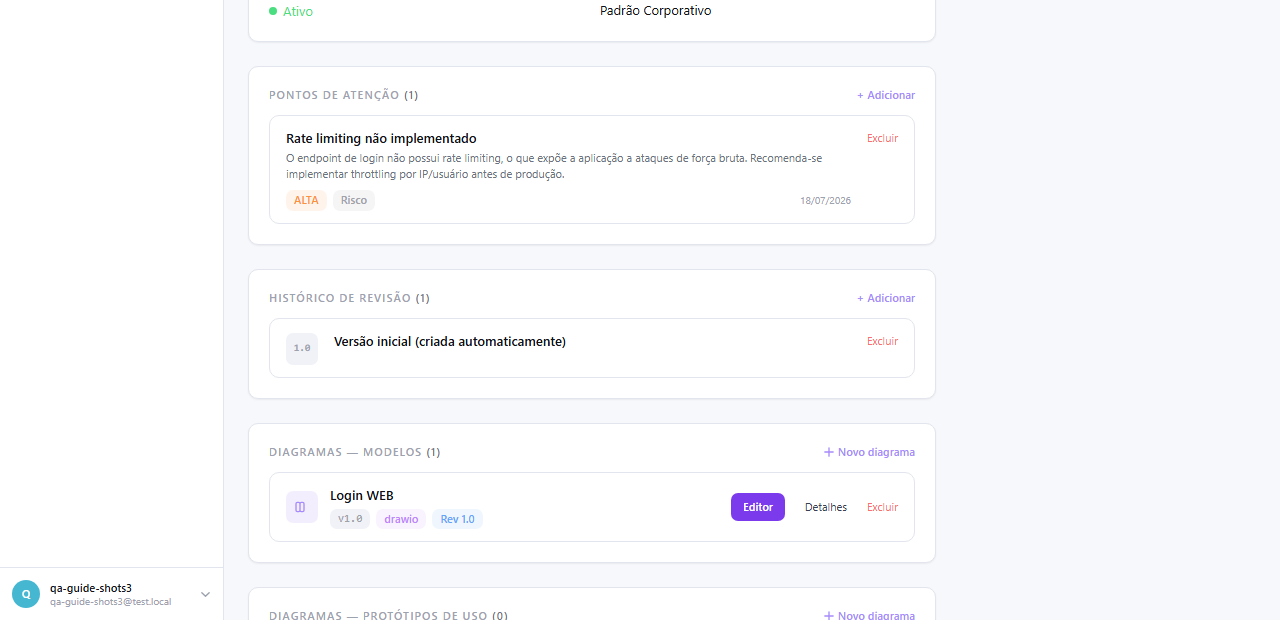
Building Blocks (ABB/SBB)
Pattern governance, not just a static catalog.
Inventory structured across the 4 C4 levels
Every entity in the platform maps directly to a C4 level — from the system as a whole down to the code artifact.
Application — System Context
A view of the system and its external actors. Groups child containers.
Container (Provider) — APIs, Databases, Frontends
Deployable units with technology, hosting, and lifecycle.
Component / Domain
Internal modules of a container, mapped to business functions.
Artifact — Workers, Libs, APIs
Technical units with repository, pipeline, SLA, and RPO/RTO.
Gnarus: the architecture copilot built into the product
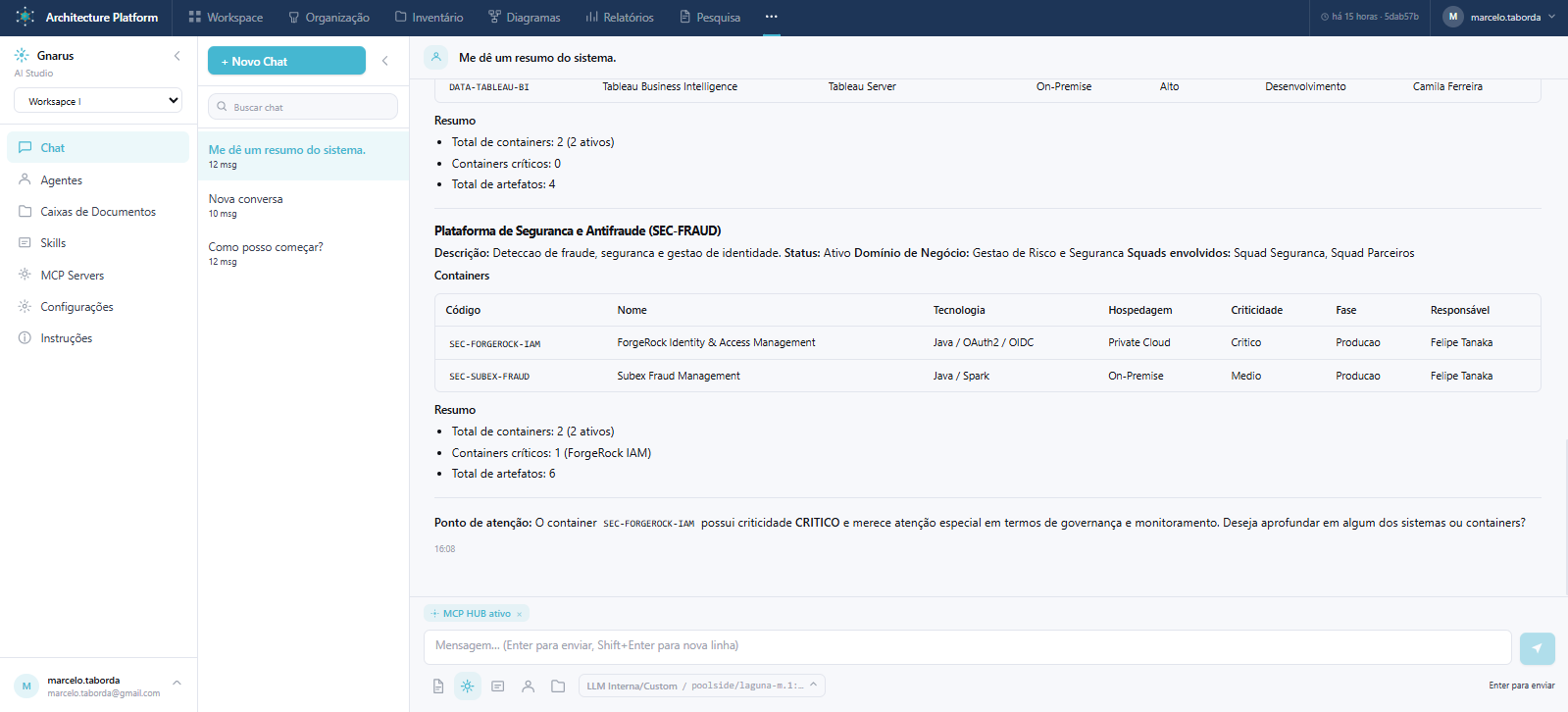
AI agents with your organization's own knowledge, right in the workflow — not a separately billed add-on.
Agents configurable by your company
Model, temperature, prompt, starter questions, and visibility — no data team required.
Context from corporate documents
The copilot answers using your organization's own standards, not generic knowledge.
Skills, chat, and MCP connectors
Conversation history and integration with external systems via MCP.
Multi-provider
Anthropic, OpenAI, Groq, or your own endpoint — keys always encrypted (AES-256).
Market data, not guesswork
Answers about end-of-support use real dates synced from endoflife.date — the same kind of data Technopedia charges extra for.
Connected to your company's ecosystem
Public API, webhooks/Teams, automatic discovery (Entra ID, Azure), Jira/Azure DevOps integration, and a native OData feed for Power BI — no spreadsheet exports.
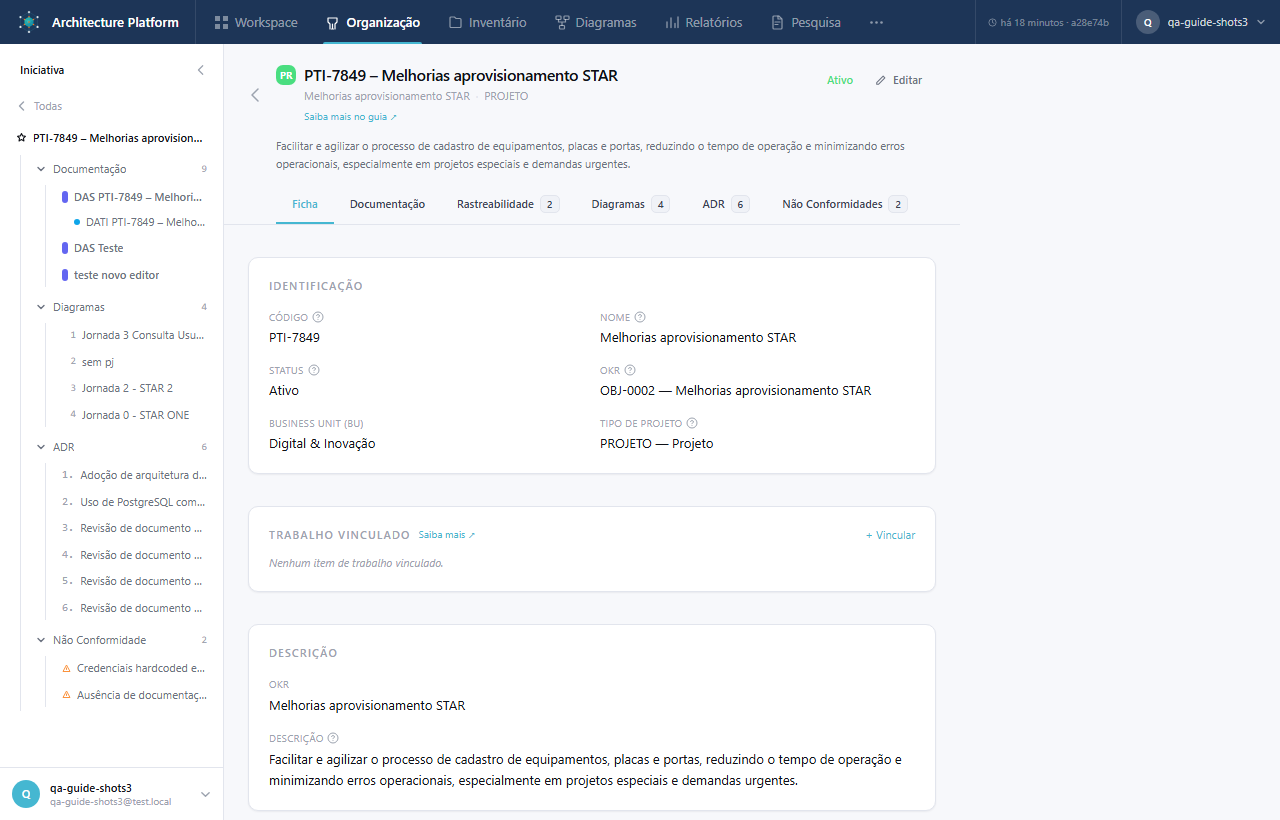
Process and control built into the inventory
The platform isn't just a catalog — it embeds the governance mechanisms that guarantee traceability and compliance of architectural decisions.
Architecture Decision Records
Document every architectural decision with context, rejected alternatives, and consequences. ADRs can supersede one another with full traceability.
Non-Conformities
Record deviations from the architecture standard with severity, root cause, corrective action, and deadline. Status flow: Open → In Progress → Resolved.
Solution Document
Integrated wiki to produce the initiative's Solution Document with a rich-text editor, versioning, and controlled publishing.
Technical Architecture Document
Technical documents nested under the Solution, covering specific domains — organized as a tree within each initiative.
From strategy to code artifact
Every element in the platform is part of a traceability chain that connects business decisions to technical implementations.
Fully auditable end to end — every technical requirement traces back to the business need it came from.
Workspaces isolate portfolio subsets by team or domain
Diagrams stay linked to the inventory's containers and artifacts
Releases track which artifacts changed in each delivery
Business Functions linked to the containers that support them
Your current inventory loads in minutes, not months
CMDB importer with assisted deduplication — no manual spreadsheets, no repeated data entry.
Upload
Upload a ServiceNow export or a CSV from your current CMDB/spreadsheet.
Fuzzy deduplication
The importer compares and scores similar records, flagging likely duplicates by score.
Review queue
Human review before publishing — nothing enters the inventory without confirmation.
API governance, built into the inventory
With competitors, cataloging and governing APIs means a second platform, bought separately. In Gnarus, it's a module that already talks to the rest of the inventory.
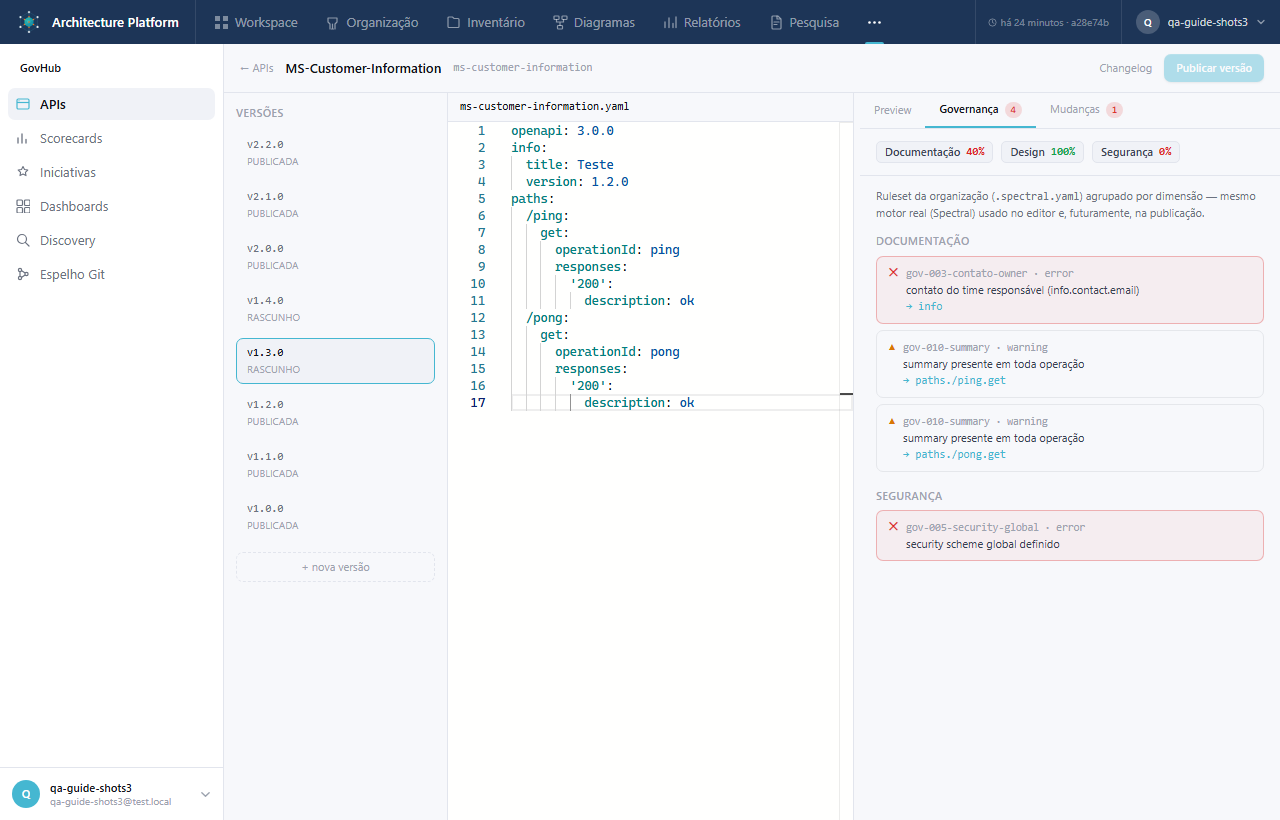
OpenAPI editor with governance linting
Your organization's rules applied in real time — documentation, design, and security scored by dimension.
Semantic versioning gate
Breaking changes get blocked until they become a major version.
Shadow APIs and gateway drift
Routes exposed outside the catalog go into an automatic regularization queue.
Connected to whoever already works with your architecture
Public MCP Server
81 tools that open the inventory to external AI agents — a corporate AI assistant can query the company's architecture in natural language, using a personal token as credential.
Corporate wiki
Company documentation organized into workspaces and pages, with versioning and unified login — alongside the TOGAF documentation per initiative.
A superior method, at a fraction of the cost.
Spreadsheets don't scale. Global application portfolio platforms solve the inventory problem — but treat TOGAF, requirements traceability, and AI as an exception or an add-on.
| Feature | Spreadsheets | Gnarus Platform | Global platforms |
|---|---|---|---|
| Native TOGAF documentation (phases A–H) | No | Yes | Rare |
| BR → TR requirements traceability | No | Yes | No |
| Formal ADRs with supersession chain | No | Yes | Rare |
| Native AI in the workflow | No | Yes | Add-on |
| Affordable for the mid-market | Yes (but doesn't scale) | Yes | No |
Grow at your own pace — pay for what you use
Two pricing axes combined: how many people use the platform, and how many systems you've mapped in it. The architecture and AI core come standard in every plan — never an upsell.
By named user
Administrator and Architect count in full; Manager counts as 0.7×; Viewer is unlimited from Professional up — broad visibility shouldn't be what blocks your team's adoption.
By CMDB asset
Tiers by number of registered Systems (up to 100 · up to 500 · up to 2,000 · custom) — reflects your portfolio's real coverage, not just how many logins exist.
Starter
The first architecture team structuring the portfolio.
- EA/CMDB core + TOGAF A–H + traceability
- AI (Gnarus) with a monthly usage limit
- Up to 100 CMDB assets
- Email support
- Wiki, public API/MCP, Planner, Discovery
Professional
An established architecture department, multiple Towers.
- Everything in Starter, with a generous AI usage limit
- Up to 500 CMDB assets
- Corporate wiki + public API + MCP included
- Planner, Discovery, and Ceremonies as standalone add-ons
- Priority support
Enterprise
The whole organization, multiple business units.
- All modules included: Planner, unlimited Discovery, Ceremonies, Sandbox
- GovHub — API governance
- SSO/SCIM + advanced audit
- CMDB assets tailored to you
- SLA and a dedicated account manager
Seat composition is a starting point, not a ceiling: every plan lets you buy extra seats by profile, and no module requires a full plan upgrade just to try a single feature. Talk to the team for a proposal calibrated to the size of your portfolio.
Access control and compliance, in production
What's already live — and what's on the way, no empty promises.
Corporate SSO (OIDC/SAML) + SCIM
Federated login with automatic user provisioning, at no extra cost — validated end to end against a real identity provider in production.
Verifiable audit trail
Every change is recorded in a hash chain — if anyone tampers with a record, the break is detected automatically. A dedicated console for querying and exporting.
Multi-workspace and roles
Workspaces isolate portfolio subsets; OWNER, ADMIN, MEMBER, and VIEWER roles control what each person sees and edits.
Revocable sessions
Short-lived access tokens with automatic renewal; any session can be terminated remotely from the "My Sessions" screen.
Encrypted secrets
AI provider keys and external integration secrets are always encrypted (AES-256), never in plain text.
LGPD by default
Contact data capture with explicit consent and a published privacy policy.
A public, honest roadmap: SSO, SCIM, and the audit trail above are already in production. Still in progress: named certification with Okta and Microsoft Entra (today: compatible with any open OIDC/SAML provider) and formal certifications (SOC 2, ISO 27001) — nothing on this page describes a feature that doesn't exist yet.
Born in Brazil, built for the world
Gnarus's advantages aren't local — the TOGAF method, end-to-end traceability, and native AI hold up in any market. We invest in three layers at once, so each one funds and validates the next.
Native English, Spanish, and Italian
Interface and user guide already available in 4 languages. Next steps: API documented in English (OpenAPI), data residency aligned with LGPD/GDPR, and the first formal certifications (SOC 2, ISO 27001).
Operational TOGAF as a lasting edge
While global leaders sell inventory, Gnarus embeds the process — TOGAF, traceability, and ADRs are part of the product. We keep investing here before competing purely on feature lists.
Every new customer validates the next market
We started with mid-size and large Brazilian companies that global leaders ignore on price. Measurable reference cases come before each expansion — Latin America first, then beyond.
"The path exists — other enterprise architecture platforms started regional and became global standards within a decade. We have the method and the native AI they didn't have at the starting line."
FAQ
How much does it cost?
The Starter, Professional, and Enterprise plans combine billing by named user and by CMDB assets — see the full breakdown in Plans or talk to the team via the "Schedule a demo" button for a proposal calibrated to your portfolio.
How do I migrate my current inventory?
Use the CMDB Importer: upload a ServiceNow export or a CSV, review the score-flagged duplicates, and publish. See the Painless Migration section.
Where is my data stored?
On our own infrastructure, with practices aligned to LGPD. Full details in the Privacy Policy.
Is the platform LGPD compliant?
Yes — capturing contact data requires explicit consent, and you can request access, correction, or deletion of your data at any time.
Is it self-hosted or SaaS?
Today we operate as SaaS on our own instance. Support for a dedicated self-hosted deployment is on the roadmap — talk to the team if that's your case.
How does support work?
Direct support from the product team during the initial adoption period. Schedule a demo to learn about the full model.
What's next on the roadmap?
Already available: management reports, corporate SSO (OIDC/SAML) + SCIM, audit trail, public API, webhooks, automatic discovery (Entra ID/Azure), Jira/Azure DevOps integration, Power BI feed, API governance (GovHub), project management (Planner), governance Ceremonies, and the MCP server for AI agents. What's next: named identity-provider certifications, formal certifications (SOC 2/ISO 27001), and multi-region operation — see the Security and trust and Vision sections.
Start documenting your architecture today
Create your account and get full access to the C4 inventory, diagram editor, ADRs, Non-Conformities, and documentation (Solution Document and System Architecture Document).
Or get product updates by email: